Why Do Value Chain Analysis?
Value chain analysis is a practical framework for understanding how things are made, who does what, who gets paid what, and where leverage exists for change. It is used across development, business, finance, and technology. Today we apply it to coffee.
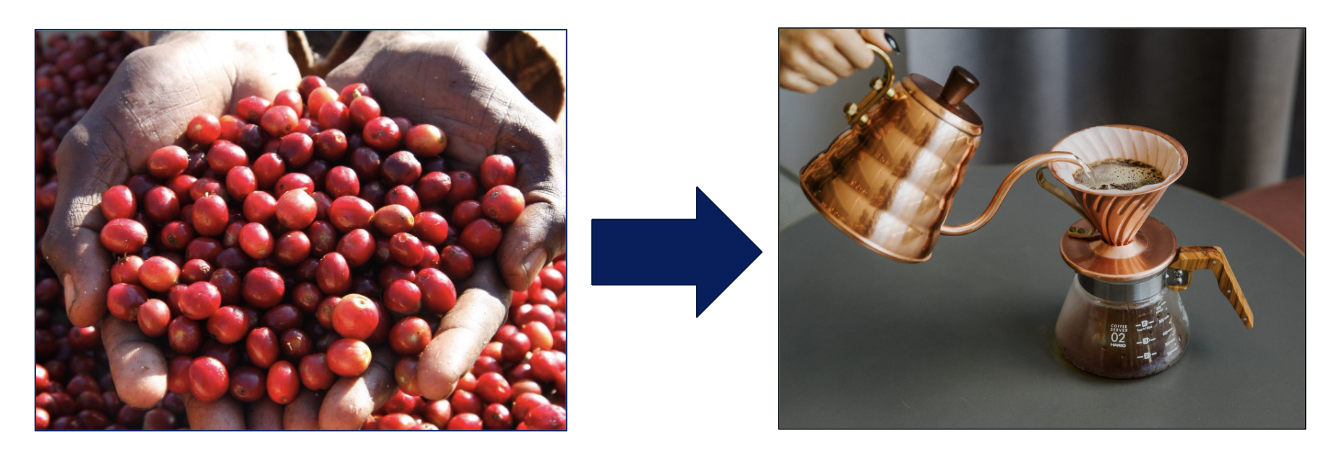
How much value does the farmer capture?
One of the most common questions I have gotten from students over the years is:
"What share of the price the consumer pays actually goes back to the farmer?"
I have been tracking this anecdotally every year as part of the lecture:
| Year | Farm-gate price ($/kg green) | NYC specialty cup | Farmer's share of retail |
|---|---|---|---|
| 2026 | ~$5.67 | ~$5.75 | ~2.0% |
| 2025 | ~$4.50 | ~$6.00 | ~1.5% |
| 2024 | ~$4.00 | ~$6.00 | ~1.3% |
| 2023 | ~$4.00 | ~$5.00 | ~1.6% |
| 2022 | ~$4.00 | ~$4.00 | ~2.0% |
The quick version of the answer is: 1-2%. The farmer's share of the retail cup price has stayed between 1-2% for as long as I have been measuring it. Absolute prices have changed but the structural ratio hasn't much.
Why? And what, if anything, can be done about it?
Today you'll learn how to derive the answer to this question yourself. More importantly, you'll learn a framework for analyzing value chains and diagnosing where the problems are. Let's walk through the math for this year's numbers.
Basic coffee value chain math
An Ethiopian farmer picks coffee cherry from her trees and sells it at the local market. That cherry is processed, exported, roasted, and eventually brewed into a pour-over at a specialty cafe here in New York City.
There are some physical conversions to keep in mind:
- Six kilos of cherry coffee yield about one kilogram of green coffee.
- One kilogram of green coffee yields about 50 cups of brewed coffee. (We'll assume it's strong, pour-over coffee.)
There are also some currency conversions:
- Consumers in the US pay for cups of coffee in dollars
- Farmers in Ethiopia sell cherry in Ethiopian birr (ETB). The exchange rate is about 127 ETB/USD.
Finally, we need to know the prices at the start and end of the value chain:
- Farm-gate cherry price: 120 ETB/kg (Sucafina 2025/26 harvest report)
- Brewed specialty coffee price: $5.75/cup (average pour-over price at a specialty cafe near Columbia's campus in March 2026 according to ChatGPT)
Now we do some math:
-
Convert the farm-gate cherry price to USD: 120 ETB/kg ÷ 127 ETB/USD = $0.94/kg cherry
-
Convert the cherry to green equivalent: $0.94/kg cherry x 6 = $5.67/kg green equivalent
-
Convert the green equivalent to cups: $5.67/kg green equivalent ÷ 50 cups/kg green = $0.1134/cup
-
Calculate the farmer's share of the retail price: $0.1134/cup ÷ $5.75/cup = 2.0%
So, the farmer captures 2% of the retail value.
Is 2% a lot or a little?
In objective terms, 2% may seem like very little. After the coffee leaves their farm, it undergoes a series of value-adding steps: processing, export, roasting, distribution, and ultimately brewing into a cup of coffee.
The final stage -- from roasted bean to cup -- generates more than 80% of the retail value. Example: You can buy specialty Ethiopian coffee for approximately $20 per 12 ounce bag at the supermarket, which is about $1.20 per cup ($20 / 0.75 pounds per bag x 2.2 pounds per kilo = $60 per kg / 50 cups per kg = $1.20 per cup). This is mostly a function of rent and labor costs.
On the other hand, the farmer's share of the export price is about 70%. After it leaves their farm, there are various stages of post-harvest processing, transport, quality control, and more. Is this a good or bad ratio? If we want to improve the farmer's income, is the best lever to increase her share of the export or retail price?
Or is it to keep the same share but boost the outright price? Lower her own cost of production, making her profit margin higher? Grow more coffee so her income per hectare is higher? Grow less coffee and switch to a higher-value crop?
The answer is: it depends on the context.
Value chain analysis is more than just calculating who earns what in a food system. It's about putting numbers like 70% of the export price into context and then determining what can be done to improve the situation.
Let's jump in!